Venture to the last protoplanet
After travelling for almost four years, the Dawn space probe arrived at the Vesta planetoid last weekend.
Max Planck scientists have front row seats in the exploration of the asteroid with two onboard cameras. The aim is to travel back in time to the origins of the solar system.
Text: Thorsten Dambeck


When astronomers point the Hubble telescope towards the Vesta planetoid, they play their last trump card. With its eagle eye, the space telescope is known to provide the clearest possible images of celestial bodies. However, Vesta has beaten even Hubble: the photos it took in 2007 are reminiscent of the view of Mars which is obtained with a run-of-the-mill telescope - a few blurred light and dark patches and a slightly non-spherical form; it is difficult to recognise any further detail on the small body, although Vesta is the third-largest planetoid. Ceres, number one in terms of size, has nearly twice the diameter - around 1,000 kilometres. Astronomers have known about the two asteroids for two centuries; however, only now is their exploration really taking off: Vesta and Ceres are on the flight schedule of Dawn, one of NASA’s probes. It entered into an orbit around Vesta on Saturday after a journey taking just under four years.
On board are two cameras - so-called framing cameras - which were constructed and developed by a team led by scientists from the Max Planck Institute for Solar System Research (MPS) near Göttingen, Germany. Both instruments have an identical construction and the feat they have to pull off is to convert an expanse of terra incognita in the solar system into charted territory. Dawn’s mission is also directed at the chemical-mineralogical composition of the surface rocks of both celestial bodies. The ultimate aim is to answer one of astronomy’s most important questions: how did the planets of the solar system come into being?
For a long time it was assumed that asteroids were debris from a burst planet beyond Mars’ orbit, as several hundred thousand members of Vesta’s family orbit the sun, most of them in the so-called main belt between Mars and Jupiter. However, the hypothesis of the shattered planet has long been passé and, at any rate, it would have been tiny: all the planetoids of the main belt taken together do not even amount to the mass of our moon. Planetologists now tend to hold the view that the planetoids are a kind of planetary building material that was left over when the worlds of our solar system were built.
The last of its kind
“We now know that the giant gas planets and the terrestrial planets were born in different ways,” explains MPS Director Ulrich Christensen, who is a member of Dawn’s scientific team. “In the protoplanetary disk of gas and dust, the first planets to form were the gas giants Jupiter and Saturn, which both required only a few million years for this.” The formation of the terrestrial planets was a more protracted process, however. Back in the 1970s, USA planet researcher George Wetherill had already assumed that it was a multi-stage process: the first primal bodies to measure at least a few kilometres were so-called planetesimals, which grew by means of collisions. According to Christensen: “Some of them increased their mass very quickly and thus formed the first protoplanets.” Initially, these devoured only neighbouring planetesimals, which limited their further growth. Today’s planets finally formed as the protoplanets collided violently with each other. Vesta now enjoys a special status among the countless asteroids: it is probably the last protoplanet to survive the brutal phase of the planets’ birth. The exact duration of this natal phase is unclear; astronomers estimate it to be up to 100 million years.
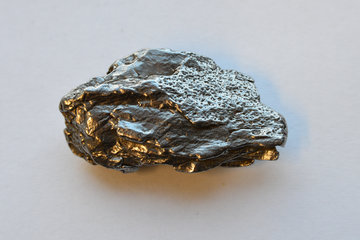
Vesta is therefore a kind of living fossil. “Some planetologists even call it the smallest terrestrial planet,” says Christensen. They base their view on a special group of meteorites: “The so-called HED meteorites are deemed to be fragments from Vesta, because their reflection spectra are very similar to that of the asteroid,” explains the geophysicist. HED is the abbreviation for Howardite, Eucrite and Diogenite, all of them rock meteorites; around five percent of meteorites are classified as HED. The chemical analysis of the celestial rocks determines the image which the scientists have of Vesta: the rocks provide them with indications of an earlier melting of its mother body – it is clear there must have been volcanism on Vesta in earlier times. Dawn’s task is to now find increased evidence for the link between Vesta and the HED meteorites.
“We assume that Vesta also has a differentiated structure similar to Earth and the other terrestrial planets. Deeper below the outer crust is a rock mantle and a metal core at the centre,” is how Andreas Nathues, the framing camera project leader at the MPS, describes Vesta’s geological situation. “Unlike Earth’s core, Vesta's core cooled down and solidified a long time ago.” On the southern hemisphere of the planetoid is a large impact crater with a diameter of around 460 kilometres. Calculations show that debris from this violent impact achieved escape velocity, which is probably how a group of main belt asteroids was formed with a composition similar to the crustal rock of Vesta, the “family of Vesta asteroids”. The impact probably also catapulted plutonic rock into space, because the diogenites among the HED meteorites consist of rock which the planetologists assume exists in the deep rock layers. No asteroid has yet been found which is similar to Vesta’s mantle rock, however.
Picture postcards from the unknown
A short while ago, Vishnu Reddy and Andreas Nathues from the MPS chalked up a success, however – in Earth’s vicinity. A number of planetoids had left their home in the main belt. Interfering forces gradually directed them to positions in the belt from where other planets deflected them into the inner solar system. These are the so-called near-Earth asteroids, which also include 1999 AT10, which was detected around ten years ago and measures around one kilometre in diameter. Infrared spectra from the rock, which were recorded a year ago by a NASA telescope on Hawaii, provided the decisive clue: in this wavelength range rocks leave behind characteristic spectral fingerprints. An initial examination of its spectrum had already proved it to be a relative of Vesta. Detailed analyses of the measurements provided further information: the rock consisted not only of calcic wollastonite, but also the ferrous ferrosilite. What does this mean for the birthplace of AT10: did it originate from Vesta’s crust or is it a fragment from deep down? According to Nathues: “Both types of mineral exist in Vesta’s crust and in its mantle, but it is the ratio that is decisive. In the case of 1999 AT10 the atomic iron content in the pyroxene is significantly lower than in all other known Vestoids.” Nathue sums up as follows: “There are many indications that we have found a piece from Vesta’s lower crust or upper mantle.”
A space probe already briefly had a fragment of Vesta in its sights: in 1999, when NASA’s probe Deep Space 1 passed the planetoid Braille, another member of the family of Vesta asteroids. Unfortunately, technical problems back then prevented scientists from obtaining high-resolution pictures of the elongated rock. The two Dawn cameras must now prove what they can do. “Vesta’s huge southern crater will be one of the first targets,” says Max Planck researcher Holger Sierks, co-investigator of the mission and responsible for developing the cameras. “Our camera has seven colour filters and an additional clear filter to enable us to take colour photographs,” says Sierks in explanation of the technical details of the five-kilogram instrument. “A single picture takes around five second. Then there is around one minute for the data compression and the relevant exposure times.” These are similar to typical values for snapshots on Earth: “The exposures through the clear filter, which transmits all wavelengths of visible light, take around one hundredth of a second. Colour filters require different exposure times, because only certain wavelengths can pass in each case and the sensitivity of the sensor varies with colour. This requires exposure times of up to 1.2 seconds.” Since the topography on Vesta is recorded from different angles, stereo views with 3D-effect will also make the asteroid “graspable” in the literal meaning of the word.
Shortly before the image stream of the two onboard cameras started, Ulrich Christensen recalled the history of solar system research. “Practically every successful mission has resulted in great discoveries: there are huge volcanoes on Mars, Jupiter’s moon Io is characterised by extreme volcanic activity, and below the icy crust of Europa’s moon there is very likely a saltwater ocean.” Dawn now has ten months to discover Vesta’s secrets. Holger Sierks can hardly wait for the photos from the orbit: “We are looking forward to the picture postcards from completely unknown territory.”