Outsmarting optical boundaries
Trying to controvert a seemingly incontrovertible law is a hard job. And Stefan Hell discovered just how hard when he attempted to thwart the resolution limit of optical microscopes. Initially, his ideas fell on deaf ears. Today, however, Stefan Hell is a Director at the Max Planck Institute for Biophysical Chemistry and since 2014, Nobel Laureate.
Text: Uta Deffke


One Saturday morning in the fall of 1993, Stefan Hell was sitting in his student apartment in Turku in southwest Finland, leafing through a book on quantum optics. The physicist from Heidelberg had just settled in the chilly north and he was hot on the trail of an idea that had been driving him for years: to revolutionize the resolving power of light microscopes.
For 120 years, the findings of German physicist Ernst Abbe in 1873 were considered to be set in stone: it is impossible to discern similar structures smaller than 200 nanometers in size with a light microscope. Stefan Hell is now pushing this limit. “I was convinced that it could be done,” he says. For years after completing his doctorate in physics, he struggled to obtain one stipend after the next, as few – if any – seriously believed in his idea. The concept alone was too absurd.
Although he had a rough plan for overcoming the resolution limit, he lacked the decisive trick to make it a reality. As he scanned through the book in search of suitable quantum optic phenomena, his eye was caught by the “stimulated emission” by which molecules that are excited to fluoresce can be switched off temporarily. “At that moment, it dawned on me. I had finally found a concrete concept to pursue – a real thread.” Biologists today study numerous cell processes with the aid of fluorescence microscopy, in which proteins and other cell components are marked with luminescent molecules.
"It was a sensation at the time"
Hell hurried to the institute and took his first stab at a new principle of microscopy. It quickly became clear to him that the resolution would drop to at least 30 nanometers – one tenth of the previous limit. “At the time, the very idea was a sensation,” Hell says, recalling the most exciting moment in his professional career. “But it was also clear to me that, in principle, there was no lower limit.” He was in a fever of excitement for the rest of the weekend. “I sat alone for a day and a half with this strange feeling: I probably know something that no one else knows, and that could be hugely important.” He thought it through again, wrote it down and carried out a few rough computer simulations.


On Monday morning he was finally able to tell his colleagues and his boss. “He just looked at me, and I could see no reaction in his face whatsoever,” Hell recalls. The Finns, he says from experience, tend to be very restrained, not given to saying a lot. “Then I said, ‘It works, it works!’ And he replied dryly: ‘On paper.’” He was right, of course. In the beginning, it only worked on paper.
On a sunny day almost 16 years later, Stefan Hell sits in his spacious office at the Max Planck Institute for Biophysical Chemistry in Göttingen. He is one of the institute’s Directors, and heads the department of NanoBiophotonics. The phone rings. NATURE, one of the world’s leading trade journals, wants to run an article on Hell and his microscope and needs the latest images. And an industry colleague urgently needs to discuss the details of a joint grant application to the German Ministry of Education and Research (BMBF). Stefan Hell is in demand.
In his mid-forties now, dressed in black jeans and a white shirt, he looks relaxed as he sits at his desk. What few hairs were left have bowed to the razor, and his full lips curve easily into a smile as keen eyes look out through rimless spectacles set on a friendly face. He has arrived.
Stefan Hell’s novel microscope has since slowly matured. In his laboratories, it produces fascinating images of cells and neurons and showed, for the first time, how individual messenger vesicles bind with nerve terminals. The first versions are available for purchase and are already providing valuable services, helping biologists and medical researchers who are searching for the molecular causes of disease or studying how drugs work. The device might well be called a nanoscope, given its current resolution of around 15 nanometers – a feat that few would have considered possible.
Long battle for money and recognition
Hell has even won over the skeptics, and not just them. Stefan Hell is famous. The list of prizes that his work has earned him in recent years is impressive. In 2006, for example, he received the German Federal President’s 10th Innovation Award, worth EUR 250,000. That was followed in 2008 by the Leibniz Prize, Germany’s most pres- tigious research funding award, with prize money of EUR 2.5 million. “Of course it’s nice to be recognized. It shows that you got it right,” says Hell. And the awards make day-to-day life as a researcher easier: “My people have better working conditions, and it’s easier for me to raise additional funding.”


But it was a long, hard struggle for both money and recognition. It all began in a technology park in Heidelberg, where Hell sat and tinkered with his dissertation in the late 1980s. At a company called Heidelberg Instruments, which his professor and Ph.D. supervisor – a successful low-temperature physicist at the university – founded jointly with a colleague. Hell’s job was to inspect semiconductor chips using the then-new technique of confocal microscopy, in which the object is scanned by a focused laser beam.
His real passion was actually for basic research. But in view of the glut of physicists at that time, even the German Physical Society (DPG) warned against choosing such a career. “And light microscopy, which was the field that I more or less bumped into, was basically 19th century physics; all the work had already been done – at least that’s what people thought,” says Hell. “Because I was a little frustrated and was instinctively looking for something fundamental, I kept thinking: It might just be possible to knock down the diffraction limit!”
"A developer is something I’ve never been"
Because of diffraction, it is impossible to focus light waves sharper than half a wavelength. Hell clearly understood that there was little he could do to alter this fact. However, with the aid of 4Pi and STED techniques, he fundamentally changed the resolution issue (see MaxPlanckResearch 1/04, p. 20ff). Using two opposing lenses, the 4Pi microscope sharpens the focal spot in the direction perpendicular to the focal plane to a fifth or even a seventh of the usual value. The STED – STimulated Emission Depletion – microscope sharpens the focal spot in the focal plane, currently to less than one tenth of the value permitted by Abbe’s law. However, the STED microscope was to be only the first of a whole family of diffraction-’unlimited’ light microscopes, because in principle, as Stefan Hell also quickly recognized, certain other processes in a fluorophore are also suited to temporarily switch off the glow of a fluorescent marker.
“Some biologists may see me as someone who develops equipment for them – but I’ve never been an instrument developer at heart,” says Hell. “I was fascinated by the idea of delving into an old question of physics that everyone thought had been answered once and for all. I wanted to know if it works. It was a matter of principle.” Hell has always been driven by the desire to get to the bottom of things: “Even as a schoolboy, I always wanted to know where the crux of the matter lay.”
Grandparents’ money as startup capital
Stefan Hell spent his childhood in a German-speaking town near the Romanian city of Arad, in the Banat region on the border to Hungary. He was born there in 1962 and attended a Germanlanguage school where he took special classes in mathematics and physics. His parents, an engineer and an elementary school teacher, encouraged his talent for science. They also had practical reasons for doing so, says Hell. History and literature were strongly tinged by communist ideology, whereas the sciences retained their independence, and would be useful wherever he went. “There were no communists in our family,” says Hell, “and my parents and grandparents had seen for themselves how quickly political systems and public opinion can change.” Even in the 1970s, it was clear to ethnic minorities in the country: if you have the chance to go, then go.


The chance came for the Hell family in 1978, and they moved to Ludwigshafen. The parents found work there, and their gifted son had no difficulty finding his way in the new environment. He was top of the class not just in math and physics, but in German, too. Linguistics and etymology became a kind of hobby that he still enjoys. “Once again, I wanted to discover the connection between words derived from various Germanic languages, and how phonetic changes developed.”
Recognizing connections was also integral to his study of physics: “To be honest, I have always been a little scornful of people who learn things by heart,” Hell admits. He attended the university in Heidelberg, where he also earned his doctorate. At the time, Stefan Hell attempted to interest his dissertation advisor in his quest to investigate the resolution of light microscopes, but optics was too far removed for a university chair specializing in low-temperature physics.
With no one of influence to intercede for him, he took matters into his own hands. He spent a few months in quiet seclusion until he had calculated and worked out the basics of the 4Pi microscope to the point where he was able to apply for a patent. Using the 10,000 deutschmarks that his grandparents had given him as seed capital after his dissertation, he duly did so. “I thought it might be of some commercial relevance,” he says. “Besides, everyone could then see who originated the idea. That was important because I had no publications or anything else to convince people to give me a chance.”
A rare bird among applicants
With these plans in mind, he peddled his idea from door to door – as he would often do over the next twelve years, never more than a hair’s breadth from dropping out of science. “But I always thought of it as fun. I was still relatively young and I thought: Well, if it doesn’t work, at least I will have tried.” But the conditions were not exactly in his favor. Physics at that time was more interested in elementary particles and solid states than it was in optics. Ironically, the German Research Council (DFG) had even just initiated a project to develop new microscopy procedures for use in biology. Hell, however, had no chance, not even with his doctorate in physics. With no laboratory and no mentor, he did not meet the criteria required for applicants.


“I really had no opportunity for development here in Germany,” says Stefan Hell. He managed to obtain a postdoc grant from the DFG that enabled him to demonstrate the principles of 4Pi microscopy at the European Molecular Biology Laboratory (EMBL) in Heidelberg to the point that he was able to publish some initial measurements, but that seemed to be the end of the road. In the end, it was the Finns who showed some interest. A Finnish friend from the EMBL was in contact with a professor who was experimenting with fluorescence microscopy for use in medical diagnostics. It was here that Hell laid the foundations for an entirely new field of research. He formulated the concept of STED microscopy and showed, through his initial experiments, that overcoming Abbe’s limit is physically viable.
But even in Finland he felt constrained. He needed more independence. The money ran out, so he went knocking on doors once again, from one German university or institute to the next. Finally Tom Jovin, at that time Managing Director of the Max Planck Institute for Biophysical Chemistry in Göttingen, noticed him, and saw in him a young and promising scientist who matched the profile of the institute. After an in-depth examination, he was put in charge of an Independent Junior Research Group.
Göttingen felt like paradise to Stefan Hell. “I basically had no idea how much support and freedom were possible at Max Planck.” At last he also had the right interdisciplinary environment in which to construct the microscope and to demonstrate, together with his colleagues, that it really works. In 1999/2000, they finally and impressively broke the diffraction limit, with a sixfold improvement in resolution. “But neither NATURE nor SCIENCE wanted to publish it,” Hell regrets. Initially, only insiders recognized and appreciated the results. Without a single publication in a high-profile journal, Hell lacked credibility in the eyes of German universities. And with Independent Junior Research Groups at the Max Planck Society limited to five years, the universities would be his next port of call.
Then one day Kings College in London asked Hell to give a presentation. He knew that candidates were being considered for an important professorship at the time, but after nearly 30 failed applications, he didn’t seriously think he had a chance. Following the presentation, the dean kindly invited him to dinner, then added: “We have decided to offer you the job!” Hell thought he had heard incorrectly. However, the academics in London apparently knew just who and what they wanted. They had commissioned headhunters to fill the vacant chair and already had a good idea of who they were dealing with. The terms of his appointment were due to be negotiated the following morning.
The fact that he turned down their attractive offer, along with eight others that he would soon receive from Germany and abroad, was due to the Max Planck Society. “Almost at the last minute they said to me, we want you to stay here,” Hell explains. And in fact he, too, wanted to stay. And so, con trary to the usual procedure, he was promoted from head of a Junior Research Group to Director at the Institute in Göttingen.
The realm of lasers, lenses and mirrors
Hell explains his decision with the comment, “Compared with all the other institutions, it was clear to me at that time that I would be able to work here best of all.” It was the Harnack principle that tipped the balance: in addition to a generous budget, an appointment as Director carries with it the maximum possible freedom to research precisely what interests them.


And that is what Stefan Hell proceeded to do. For his visionary highresolution project, he needed more than just physicists who could deal with optics and design laser systems. He also established a chemistry and molecular biology group whose work involves developing suitable fluorescent markers that can easily be switched on and off, and a biology group that investigates applications in the life sciences. The combination works well, Hell believes.
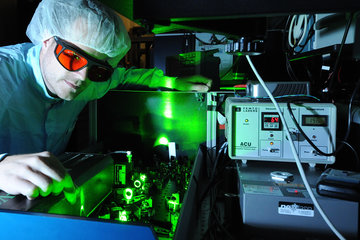
The staff works diligently in the laboratories and, it would seem, with a sense of commitment. The labs are named the Gauss Room, Debye Room and Born Room, after famous scientists who once worked in Göttingen. Here, behind the high-security doors, is a world of lasers, lenses and mirrors, dozens of them mounted on bare optical tables. Some of the microscopes are the commercial versions – built by a division of the old company that Hell worked for when he was working on his doctorate. The company has since been bought out by Leica, and now employs some of Hell’s graduates.
This is where the various procedures are optimized. Researchers are improving the temporal resolution in order to be able to depict processes in living cells. Others are working on new fluorescence molecules that can be switched at will, and dock with certain cell structures. New areas of application are also being developed – for example in materials research. New combinations of STED and 4Pi microscopy are being explored, and new fluorescence switching mechanisms created.
However, Stefan Hell wouldn’t be Stefan Hell if he simply stuck to the beaten track. “Of course we are exploring the potential of these microscopes,” he explains. In theory, there should be little or no limit to the minute dimensions they offer access to. “And that would mean that we ought to be able to see not just individual molecules, but potentially even what’s inside them,” says Hell, once again with a daring look in his eye.
Did he ever doubt that his idea would prove successful? Serious doubts – no. Even if the initial groundbreaking experiments are complex and require expensive new equipment, in Hell’s view, that’s no reason to shy away. After all, technology is developing all the time. “Envy and criticism are very important, too, because they provide added incentive, as well as highlighting the points that require attention. If an idea is powerful enough, nothing can stop it. And the idea that light microscopy was possible beyond the Abbe limit was very powerful.”
A doctor’s cap and a sword of sharply honed steel


It is his family that keeps the visionary physicist’s feet on the ground. His wife is an ambitious physician at the university clinic, so the domestic routine must be well organized. Every morning, he takes their four-year-old twins to kindergarten. And thanks to the pestering of the two boys, he regularly revisits an old passion – the saxophone. While he was in Finland, Hell took lessons in jazz and improvisation. He would like to spend more time making music – if only he had the time. Running is another thing that Stefan Hell does less often than he would like. But the family has been kept on its toes for a few months now anyway, thanks to its latest addition, a baby daughter.
Not to mention another recent offer from abroad. In spring 2008, Stefan Hell got an offer to move to Harvard. “Of course it was a great honor, and it really wasn’t easy for me to decide,” he admits. “A new building, fantastic academic environment, top people, top students – it was very, very attractive. But in the end, the opportunities I have here at Max Planck tipped the balance.”
And so it was that Stefan Hell and his family recently flew, not to America, but to Finland. In Turku, his old domain, he received an honorary doctorate – in true Finnish style, wearing a doctor’s cap and a sword of sharply honed steel. Even his former boss was visibly moved. “In those critical early days, the Finns had confidence in me,” says Hell with gratitude. “They saw the potential, and they saw a man with the energy to realize it.” Maybe the steel sword that Stefan Hell brought back from Turku is not a bad symbol of his career, and of the will to slay a scientific dragon.
GLOSSARY
Diffraction limit
A new wave is emitted from every point in a light wave, for instance when it hits the edge of an object. That is why, under an optical microscope, two objects cannot be distinguished if they are less than half the wavelength away from each other.
Confocal microscopy
A beam of light scans a sample. A pinhole in the optical path blocks image information from outside of the focal plane – the depth of focus is higher than that of a conventional microscope.
4Pi microscope
Two opposing confocal microscopes reduce the oblong focal point of a single microscope to a sphere (4Pi refers to spherical geometry).