Marine passion
Nicole Dubilier researches deep-sea bacteria and worms at the Max Planck Institute for Marine Microbiology in Bremen
Text: Klaus Wilhelm

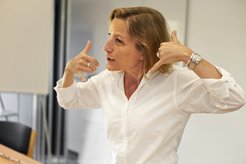
What a laugh! Over and over again, Nicole Dubilier erupts into peals of deep, hearty, contagious, spirited, congenial and loud laughter. She simply can’t help it, it seems. Even if – or more precisely, when – she is talking about the things that mean the world to her: science, family and the ocean.
The joyful, downright exuberant Dubilier, Director at the Max Planck Institute for Marine Microbiology since 2013, adopts an equally upbeat tone when recounting tales about her excursions in the Atlantic and Pacific Oceans with the research ships Meteor, Sonne, and Maria S. Merian, when explaining symbiosis – that tightly knit “marriage of convenience” between various living organisms – or the new world of molecular biology that is gradually unveiling the secrets that lie behind the phenomenon of symbiosis, or when simply talking about bacteria and worms. Yes, worms! Spontaneity and candor come just as easily to this down-to-earth woman as laughter – and research. She likes stories and life in general – and her own life. All this is immediately obvious upon meeting her.
Nicole Dubilier is sitting in her modest office on the first floor of her institute in Bremen. Pinned to the notice board is a card with birthday greetings from the crew of the Maria S. Merian, and a humorous “baptismal certificate” for crossing the equator on the high seas from the crew of the Meteor. The sparse office contains just a few desks and shelves lined with specialist books and publications. The window overlooks the institute garden and pond, and Bremen’s Bürgerpark forest is visible in the distance – it is easy to see how the view could provide a source of inspiration. “Nicole von Wurm,” as the ironic, yet highly symbolic nameplate on her office door reads, has been leading the now twelve-strong “Symbiosis” Research Group.
Menage à trois between a worm and two bacteria
The livewire from the coast – Nicole Dubilier has been living in Hamburg since the 1970s – has had a formative influence on this research field over the past decade. She was responsible for the discovery of a new form of symbiosis: a symbiotic menage à trois between a worm and two bacteria, from which, contrary to previous belief, all of the partners benefit. The discovery merited a letter in the prestigious journal Nature – the equivalent of a knighthood in the world of scientific research. “I was extremely proud at the time.” She laughs.
It was a worm from the Mediterranean shores of the island of Elba that “suddenly changed my scientific life,” recounts Dubilier. Nothing in her early years had suggested that this was how things would turn out: she had not dissected earthworms as a child to watch how they regenerated themselves, nor did she develop any great passion for the species in the early stages of her biology studies. On the contrary: like all second-semester biology students, she had to dissect an earthworm and study its anatomy, and read the notorious sentence in “Kükenthal,” the seminal German textbook on practical zoology, to the effect that: “The variety of the structures, their organization and order, and the way the colors of the tissues are coordinated will inspire all but the very dullest among us.” Dubilier laughs: “If that’s the case, I must have been very dull indeed.”
Symbiosis between worm and bacteria
Sometimes an appreciation for the fascination that lies in the unusual does not develop until later on in life. Lacking as it does the impressive physicality of a whale and the entertainment value of a dolphin, the marine oligochaete Olavius algarvensis is clearly no poster species of the marine world. However, it is no ordinary species either: that would not suit Nicole Dubilier. The exotic creature, which is just one to two centimeters long, burrows through the sediment of the sandy ocean floors of Elba’s shallow coastal waters. Under the microscope, its body is milky-white and wound like the coils of an immersion heater.

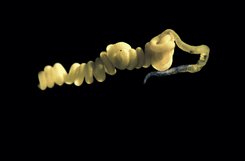
Olavius is also slim: with a diameter of just 0.2 millimeters, it is a truly svelte representative of the world of worms. It is related to the lowly earthworm, a fact that does little justice to its highly unusual features. The marine worm does not eat a bite of food, yet it lives very well. It has neither mouth nor stomach nor intestine nor bowels. In fact, it lacks a digestive tract altogether. The anatomist would also search its body in vain for kidney-like organs for the excretion of waste products, such as ammonium and urea.
As far back as the early 1980s, American scientists discovered tubeworms at the bottom of the deep sea – on black smokers at boiling hot hydrothermal vents that spew a hellish soup from the depths of the Earth. The soup is fortified with hydrogen sulfide, the gas that makes rotten eggs smell bad and is poisonous to almost all animals. The tubeworms defy this risk with the help of an ingenious trick: at some point in their evolution, they assimilated bacteria that chemically convert the hydrogen sulfide and thus render it harmless to them.
Through this process, these bacterial “sulfide oxidizers” obtain energy that they use to fix CO2 into organic carbon. The entire spectacle is nothing more than a classical symbiotic relationship as, in return for the nourishment, the host guarantees its guests constant proximity to their source of nutrition. In short: a community formed by two living organisms for their mutual benefit.


Soon after the discovery of the hydrothermal vent tubeworms, Nicole Dubilier’s doctoral supervisor, Olav Giere from the University of Hamburg, observed a similar symbiotic relationship in gutless worms that he found, not in the deep sea, but on the coast of Bermuda. These worms also thrived in sulfide-rich sediment and appeared to host bacteria.
Meanwhile, Nicole Dubilier was struggling with her doctoral thesis, which involved a physiological study. Although the topic concerned worms, she found it rather uninspiring. The weather on the north German island of Sylt, where she did her fieldwork, was miserable. “I had my own personal rain cloud,” she laughs. She had always firmly believed that a career should involve passion and fulfillment. And now this!
She had given up on her first dream of becoming a classical ballerina at the age of 15. Prior to that, she had practiced with unwavering dedication at the ballet barre every afternoon after school. She even passed the entrance examination for the prestigious training school of the renowned Stuttgart Ballet. Then everything changed. As a teenager, she became very interested in the politics of the time. “It was impossible to have a sensible conversation with those ballet girls.” A loss for words is foreign to her nature, and empty chatter no less so. And, “my dancing career would have been over by the age of 30 anyway.” This woman is judicious in her actions. She approaches every aspect of life with a lively mind and sharp intellect.
Nonetheless, she held on to her dream of fulfillment. While she was doing her doctorate, however, the next dream also appeared to have shattered: that of becoming a fulfilled researcher, someone who is so engrossed by their subject that they even muse on it creatively while taking a shower. On three different occasions, Dubilier was tempted to throw in the towel, but each time she gritted her teeth and carried on.
After a long, six-year struggle, the determined and strong-willed woman finally received her doctorate in 1992. It was clear to her, however, that she would not be able to survive many more years like this, as “it is frustrating when you work hard and remain unfulfilled.” The plan: “I’ll give myself one more year as a post-doc,” working on a different topic, doing a different kind of research. She would soon know if it really gratified her: it would have to feel like ballet.
Symbiosis drives evolution
It turned out to be molecular biology, or more specifically, the symbiosis between worms and bacteria, that provided the satisfaction she sought. Molecular biology provided the right path because, in a way, it is less tedious than physiology. “When it works, that’s it. You don’t have to repeat the experiment five times,” says the researcher. What fascinated her about symbiosis was the idea of cooperation; the fact that evolution is not driven solely by egoism and competition, and that cooperation and reciprocity can also be the engine of evolution. In this life form, each participant contributes something that helps the other participant. “That touched me,” she says. “So much so that it grieved me when some symbionts “cheated” on their partners.”

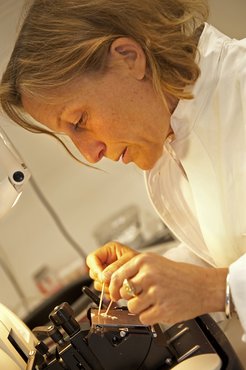
This could be interpreted as a typically female perspective on things: cooperation instead of egoism. However, Nicole Dubilier counters such an interpretation with hard facts and the conviction of an inspired researcher. She goes on to explain how symbiosis is an ancient process: without symbiosis, life would not have been able to develop on Earth. The symbiosis between bacteria and primitive protozoa, in particular, fueled the spread and evolution of plant and animal cells, and shaped the development of life on Earth.
Today, almost all plant, animal and human cells, with their minute energy power plants, the mitochondria, still contain the descendents of earlier bacterial symbionts – without mitochondria, we would not be able to breathe. Dubilier explains that innumerable bacteria thrive in the human bowels and return the favor by supporting digestion, or possibly even strengthening the immune system. Symbioses can be found wherever you look.
It may thus come as some surprise to learn that symbiosis only gradually took off as a research field in the mid-1990s. To enable scientists to find out more about the emergence of these partnerships, as simple a model as possible was needed. Olav Giere’s gutless shallow-water Bermuda worms appeared tailored to this task. With the worm cultures in her suitcase, Nicole Dubilier headed off to Harvard University, to Colleen Cavanaugh’s laboratory, which had made a crucial contribution to the discovery of the deep-sea tubeworms with their bacterial symbionts. It was in this prestigious setting that Nicole Dubilier became familiar with the tools of molecular technology.
Creativity in her blood
The move to Harvard also marked a return to her native country: Nicole Dubilier is American by birth, with an interesting and eventful biography. Her original nationality is not immediately obvious to anyone who hears her chat in perfect Hanseatic German. However, a slight American accent creeps into her energetic Hamburg German at times. She was born in New York and grew up on the Upper East Side, one of the Big Apple’s most illustrious neighborhoods. There’s no doubt about it: the eldest of four children, Nicole Dubilier comes from a distinguished background. Her father was an American businessman and her mother a descendant of the renowned Berlin physiologist Emil du Bois-Reymond and Fanny Mendelssohn, sister of the composer Felix Mendelssohn-Bartholdy. Creativity is clearly in her blood.


Her German mother emigrated to the US in the 1950s and married there. “An explosive union from the outset,” is how the daughter describes the marriage. “My parents were like fire and water, and it was all quite chaotic.” The family moved to Germany in the 1970s, to Wiesbaden, where Nicole Dubilier completed her German high school studies at the nationally renowned Helene-Lange-Schule, achieving an excellent grade average. “I really enjoyed school,” she says. And it wasn’t just physics, chemistry and biology that appealed to her – she was also fascinated by politics, the social sciences and humanities. Discussion, protest, conflict: the young Nicole Dubilier was interested in social developments, and still is today.
Against this background, her choice of biology as a subject is rather surprising. But “I also wanted to do something with my hands, something that linked physical and mental work.” So biology it would be, preferably marine biology. Her love of the sea runs deep and was forged by annual two-month-long family holidays on Fire Island, a long narrow island off the shore of Long Island. “Paradise for us children.” Her choice of subject was also influenced by another important factor: “Given the chaotic family life I experienced, I wanted to find order and logic somewhere. In science, I thought, two plus two always equals four.” A young seeker of the simple truth. She laughs.
She would later come to understand that research only really becomes fascinating when two plus two appears to make five – at the latest by the time she reached Harvard. Resolving such contradictions carries the promise of scientific renown – as was the case in the late 1990s when Olav Giere and Swedish taxonomist Christer Erseus accidentally discovered Olavius algarvensis off the island of Elba. The find immediately presented a puzzle: no matter how thoroughly Nicole Dubilier looked, she could not detect hydrogen sulfide in the sediment of Capo Sant’Andrea Bay. All previously discovered gutless oligochaete worms (annelids) lived in sulfide-rich sediments. Moreover, electron microscope images testified that at least two morphologically different bacterial species lived inside the worms.

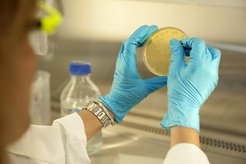
Nothing added up correctly until Nicole Dubilier decoded the symbiont’s 16s rRNA gene. This gene is considered by experts to be a kind of molecular passport for a bacterial species. This led to a pioneering discovery for symbiosis research: a harmonious menage à trois – one host with two symbionts, with all of the partners benefiting.
Because there is little or no hydrogen sulfide in the Mediterranean sediment, O. algarvensis internalized a source of hydrogen sulfide by taking up a bacterium that produces sulfide from sulfate and generates energy in the process. The familiar sulfide-oxidizing bacteria use the hydrogen sulfide in turn as a source of energy.
A cycle thus emerges in which the two bacterial species exchange their metabolic products and ends only with the death of the host. This biological construct functions so admirably that the bacteria produce an excess of organic carbon compounds from carbon dioxide, with which they feed the worm. The microbes also relieve their host of all of the inconvenient waste products that it would otherwise have to excrete. “Simply ingenious,” says Nicole Dubilier. The worm makes itself largely independent of external energy sources and can populate new habitats that have little to no sulfide. “My most important scientific contribution – and no one believed it at first.” But the doubters were silenced.
Teamwork is symbiosis
Not least as a result of this discovery, Nicole Dubilier settled for the long-term at the Max Planck Institute in Bremen in 2001. “I had always wanted to work at this institute because it offers optimum working conditions.” These include her own research group – she now has her own funding as a research organizer – an office instead of a laboratory, and the opportunity to develop new perspectives with her colleagues. “They’re great,” she says warmly. “The teamwork is great fun.” Just what you’d expect from a symbiosis researcher.

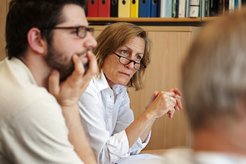
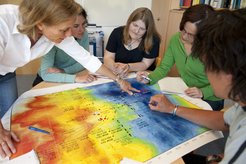
When she gets together with her colleagues, as she does on this particular afternoon, the atmosphere is constructive and friendly. The topic of discussion is the next trip to the Mid-Atlantic Ridge with the Meteor – a major event for all. Meticulous preparation is required. And when, as now, they all beat around the bush because they don’t want to take over a routine task, the boss can also show her assertive side: “This has to be settled now, who’s going to do it?” She laughs.
Together with partners from the institute in Bremen and other institutes in Germany and abroad, Dubilier and her team regularly deliver outstanding results. The researchers have carried out in-depth studies on the
“O. algarvensis biotope” using new molecular methods, and identified up to four different bacterial species, a ménage à plusieurs involving two sulfate reducers and two sulfide oxidizers. Surprisingly, all four symbionts fix carbon dioxide. Why the redundancy? That remains unclear.
The different metabolic systems may perhaps be used in different sediments, in predominantly oxygen-rich upper layers of sand and in predominantly nitrate-rich deeper layers of sand. What is clear is that the worm has a regular symbiotic powerhouse built into its body. “O. algarvensis shows how limited resources can be used through the cooperation of microbial communities that are tailored to each other’s needs,” explains Nicole Dubilier. The worm-bacteria symbiosis could thus provide a model for an almost self-sustaining biosphere. Such systems are required on a large scale by space travel, for example for long expeditions to Mars.
Nicole Dubilier always refers to such examples in response to the repeatedly asked question as to what purpose her “symbiosis science” could possibly serve. She then explains a bit about the carbon budget of the oceans and how the well-being of the sea is directly linked to species diversity, as well as how many of the processes associated with symbiotic bacteria could also be important for infection research. Yes, that too. More than anything else, Nicole Dubilier likes to enter unknown territory, and to keep an eye out for the unexpected, free from the ties of applied research.
The Leibniz Prize, which Dubilier received last year in 2013, provides her with an even greater deal of autonomy. She will be able to use the prize money of 2.5 million euros for her research as she sees fit and without any beaureaucratic obstacles. "My objective is to use this money to show how important symbiosis is for the world's oceans," she says. "They play a key role in the biodiversity and ecology of our oceans, particularly where resources are scarce, for example, in the deep sea."
Whale carcasses - habitats of the deep sea
The research of mussels in the deep sea is a different, but not less interesting research field for Dubilier. The bivalves carve out a rather miserable existence on whale corpses, hydrothermal vents and cold seeps where hydrogen sulfide can be found. They cultivate bacterial symbionts in certain cells of their gills and constantly pump a mixture of seawater containing oxygen and sulfides to them.

While studying this symbiosis, the Max Planck team also discovered bacteria that infect the nuclei of mussel cells. Interestingly, these parasites only penetrate into the nuclei of cells that do not have symbionts. “We therefore assume that the symbionts can somehow provide protection against infection,” says Nicole Dubilier. Her colleagues have now demonstrated the presence of such nuclear infections in commercially available blue mussels.
This makes researching this phenomenon somewhat less difficult, as shallow-water mussels are easier to access than their deep-sea relatives. Although, of course, the mere idea of an excursion to the world’s oceans immediately makes Nicole Dubilier’s eyes light up: “I am simply happy on the ocean.” She perceives it as a privilege to set sail at least once a year with the Meteor or the Merian, and to feel the ocean wind in her face.
But everyday life on board is sometimes hard. It starts early in the morning when the unmanned remotely operated vehicle (ROV) dives to the bottom of the sea and the scientist sits in the small dark container with the pilots who fly the ROV, watching the large screen showing the images it captures. “It’s like sitting in the middle of it yourself,” she says, with obvious enthusiasm. It is her job to tell the pilots what they should fish from the ocean sediment using the ROV’s manipulator arm – mainly mussels of late. “When it goes well, it’s great fun, and when it doesn’t go so well, you bicker.”
And in the evening, when the ROV has come back up again, the work continues for the researchers, preparing and analyzing the animals and microbes in the ship’s laboratory. “My colleagues are surprised when they see that I still know my way around a laboratory,” says Dubilier. The job can take all night. “Holding a mussel from the depths of the ocean in your hands and sniffing it to see whether it smells of sulfide is incredibly satisfying.” And she loves the times when, after 20 hours of hard toil, completely tired and bleary-eyed, she gets together for an early morning chat with her equally exhausted colleagues.
For a while, Nicole Dubilier did not participate in such trips any more. Only since her son turned eight - which is eight years ago - did she go onboard again. And only because she knew at the time that her husband will take over the child care in her absence. “He’s wonderful at it.” Here, too, she fosters the idea of cooperation. “I had agreed with my husband that we would share child care equally, and we’ve stuck to the deal.” That’s Nicole Dubilier: mother, marine biologist, molecular biologist and microbiologist, the power-woman who wants to work until she’s 80, if she’s allowed to. And who just wants to be able to say “my team is doing the best research in the world.” She laughs. Of course.