Age touches a nerve
Philipp Khaitovich works in Shanghai, a city that is developing at a pace as dramatic as his research field. This makes for an inspirational environment. At the CAS-MPG Partner Institute for Computational Biology, the molecular biologist is investigating how the different brain development of primates is linked to their age.
Text: Martin Paetsch


When Philipp Khaitovich opens the door, he is greeted by a draft of fresh air. In the small room, it is noticeably cooler than outside in the hallway that, on this beautiful spring day, is bathed in sunlight. Inside, machines are humming. The room is packed with white cabinets and deep freezers. The freezers are covered with digital displays; a temperature recorder controls the degree of coldness inside: -80°C or lower. “Actually, it’s a waste of space,” says the young researcher, who heads a research group here in the Chinese metropolis of Shanghai. He would like more room for his students or for the small laboratory next door.
Inside the freezers are the treasures of his research team. There are dozens of brain samples from humans, chimpanzees and rhesus monkeys of different ages that Khaitovich has painstakingly collected. Using the pieces of tissue stored here, the scientists are seeking to discover more about the differences between humans and monkeys. By comparing the activity of genes and the concentration of various molecules in the brain samples, the team can determine how the development and aging progresses in the different species on the molecular level.
So what is it that makes Homo sapiens so special?
The research conducted should help provide answers to some of the fundamental questions in biology: Why do Homo sapiens live so much longer than closely related primates? What makes our species so special? “These are, of course, major questions,” says Khaitovich in his office, a bright room where he looks out of the window onto a street lined with sycamore trees. “And we are only a small research group.” He smiles a little apologetically, almost like someone who is trying to find the answer to an insoluble puzzle – and who knows that he can actually succeed.

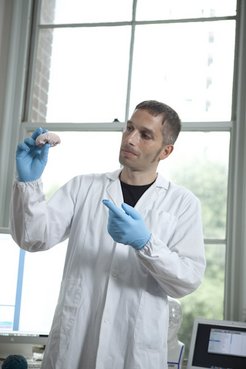
With a slightly faltering Russian accent, Khaitovich explains his project, his hands describing wide arcs in the air. He gesticulates and laughs a lot, rolls his eyes, and never takes himself very seriously. But he is serious about his work. For almost four years, the Russian has been carrying out research at the Shanghai center, at the CAS-MPG Partner Institute for Computational Biology, which has been run jointly by the Chinese Academy of Sciences and the Max Planck Society since 2005.
Chimpanzees reach puberty at the age of eight
During this time, Khaitovich has built up an international team of scientists. The researchers are young and ambitious, and many of them come from China. This is a group that does not shy away from difficult problems. Not even from problems that many great minds have wrestled with in vain in the past.
Such as the mysterious longevity of our own species. “Humans can live to be 100, in some cases even longer,” explains Philipp Khaitovich. “In contrast, rhesus monkeys, for instance, live to at most 40 years, even with the best medical care.” Humans do differ, even from their closest living relatives, chimpanzees, simply in development of their intellectual capabilities. Physical development is also dissimilar in the two species. For example, sexual maturity in female chimpanzees begins at the age of 8 or 9 years, whereas in Homo sapiens it is more like 13 or 14.
Why there is such a dramatic difference in the development of man and apes has long been the subject of research. “For a very long time, scientists have been puzzling over this question, including big names like Konrad Lorenz and Stephen Jay Gould,” says Khaitovich. “Every conceivable hypothesis has already been considered.”
There is, for example, the idea of neoteny. According to this theory, which has been debated over and over again since the beginning of the 19th century, human development is considerably delayed compared to any other primates.
The basic idea is that the adult human, with its sparse hair development, on the outside resembles the small face and big head of a baby monkey. At the same time, the human brain retains its plasticity longer, which might explain the special cognitive capabilities of our species. Up to now, however, such theories have been nothing more than just that – theories – because they cannot be validated, as such. It was only a few years ago that rapid technological development made it possible to put them to the test.
In the 1990s, when Philipp Khaitovich was studying molecular biology at the Moscow State University, this kind of research had not yet even been thought of. At that time, it took several years just to investigate the structure and function of a protein. After studying in Moscow, he went to Chicago to do his doctorate, then on to Germany where he worked at the Max Planck Institute for Evolutionary Anthropology in Leipzig.
There, in the group headed by Swedish evolutionary geneticist Svante Pääbo, he gained significant impetus for his later work. “Svante is a true pioneer. He was one of the first to use new genetic methods to investigate human evolution,” says Khaitovich. “My current subject is based largely on his ideas.”
A city on fast-forward
After six years in Leipzig, the young Russian finally got the chance to form his own research group in Shanghai in 2006. “China is developing very rapidly, and that was something that attracted me,” says the scientist. He was, however, not prepared for Shanghai, the largest city in China, which has gone into fast-forward mode. Shiny new high-rise buildings are springing up everywhere, intertwining asphalt roads and colorfully lit bridges are being built. And after almost four years, Khaitovich is still sometimes taken aback by the breakneck speed of the city with a population of 19 million people. For example, when five new subway lines are opened within the short span of just a few months. Or when a new airport terminal that did not exist a few months earlier suddenly appears.


“There aren’t many cities that are as big and have changed at such an unbelievable rate,” says Khaitovich. But the young researcher enjoys life in the modern metropolis. He wanders with friends through the lively areas of the city, visits new cafes and art galleries. And from Shanghai he can also explore the rest of the country with its deserts and mountains, and visit historic sites, like old Buddhist monasteries. On his travels off the beaten track, Philipp Khaitovich has also stayed in simple farmhouses.
The researcher has been learning Chinese for two years, but his language skills are still “quite poor” in his opinion. He talks to his Chinese friends who he has gotten to know in Shanghai in a mishmash of Mandarin and English. Together they indulge in the truly greatest Chinese passion – food. They visit restaurants where very few foreigners stray, sample delicacies from all over the country, including, for example, “stinking tofu” – a fermented soya dish that gives off a pungent smell. Khaitovich goes into raptures about a “whole universe of dishes” tucked away in the streets and alleyways of the big city.
However, Shanghai is virtually the ideal site not only for culinary exploration, but also for his research project. The dramatically changing metropolis is a little like modern biology, Philipp Khaitovich finds. Because in his discipline, too, developments have experienced a meteoric rise during the past few years and technological progress has constantly opened up whole new avenues. Therefore, it is only logical that Khaitovich has set up his research group here.
Computer scientists and biologists in one group
And Shanghai has a number of locational advantages. “In Germany, it is difficult to encourage students with good computer skills to join a group like this,” says the Russian. “Here it is much, much easier.” His team does around 70 percent of its work on computers; for his research, however, Khaitovich needs not only excellent computer scientists, but also talented biologists – and he can find both in Shanghai. In his group, he has to bring together experts from both fields and then motivate them in the other discipline.


China’s funding policy also benefits his research, as the country is investing in less well established areas of science: “It supports rather unusual projects that are simultaneously very promising,” explains Khaitovich. “Naturally, I hope that our work will be part of this,” he says with a smile.
Anyone who, like Philipp Khaitovich, is working on research in Shanghai must, however, be able to embrace a different mentality. “Those who think that their own brand of problem- solving is the only right one will have problems in China.” Instead, flexibility and empathy are needed, and people must be prepared to adapt to the different culture. Khaitovich reserves judgment about the subtle rules of etiquette and the fine differences in thinking. “Four years in China is not enough to understand these things.”
Before important discussions, he seeks advice from Chinese friends, asking about the right strategy, the right behavior. However, the cultural differences do not present real problems. “There’s no such thing as an invisible barrier,” Khaitovich emphasizes. And the cliché of collective Asian thinking whereby personal well-being is always subordinate to that of the community is not something the researcher has encountered. “My students all have very strong personalities, sometimes stronger than I would like,” he says and laughs.
What the young team does have in common, despite all the potential cultural and character differences, is the type of work. Research in China is no different than anywhere else in the world. “Science is a universal language,” he says. “You analyze data and obtain results, then interpret them – that is exactly the same here as it is in Europe or America.” Perhaps what also unites the scientists is their research object: mankind itself. Because nothing is more fundamental than this. The riddle of our longevity, the origin of our intellectual capabilities – these are subjects that concern us all.
Newborns and the elderly provide the answer
To get to the bottom of these peculiar human characteristics, Khaitovich and his students are comparing the brain samples of humans, chimpanzees and rhesus monkeys – all at different ages. To be able to gain knowledge on the development of the brain, the team needs pieces of tissue both from newborns and from the very old. And from individuals in a number of different age groups in between.


Finding the right pieces of tissue is a real challenge. Time and again, Khaitovich must persuade other institutes to cooperate, because the samples not only need to be from a human or animal of a certain age, but they also need to come from a specifically defined area of the brain. From the prefrontal cortex, for example – the area behind the brain where inherently human capabilities, such as rational thinking, are located.
The human samples cause Philipp Khaitovich the least problems. He orders them from ‘brain banks’ – facilities where brain tissue from various donors is archived for research purposes. For chimpanzee samples, he is still on good terms with his former professor in Leipzig, where Svante Pääbo several years ago began to archive the brain tissue of apes of various ages; however, it is difficult to get hold of viable brain samples from old macaques. “Rhesus monkeys can live to about 35 years of age, but there are perhaps only a few dozen animals of this age throughout the world.”
The scientists then send the samples from the various elderly humans and monkeys for analysis in partner laboratories to determine gene expressions and other data. For this, they ignore the complicated structure of the brain tissue – the samples contain different types of neurons, glia cells and gray matter. “It is as if two ecosystems, together with all the animals and plants living in them, are being compared with one another.”
Khaitovich is the first to admit that there are weaknesses in this procedure. “This is all still very primitive,” he admits. And at the moment, the technology to investigate the brain comprehensively and look at all the different cell types separately simply does not exist. Nevertheless, Philipp Khaitovich is proud of exploring new avenues: “At least I can say that we are working at the cutting edge of research.”
Feeling and elephant with your hands
For the scientist, the technical development of biology cannot advance fast enough. Sometimes he feels like a blind man trying to feel an elephant with his hands – and instead of the trunk, thinks he has found a snake; instead of a leg, a tree. All the same, he has at his disposal the most state-ofthe- art measuring methods to answer his questions on the development of the human brain. “It’s like looking at things for the first time under a microscope that you’ve been able to examine before only with a magnifying glass,” enthuses the researcher. And he can’t wait for the day when he can swap his microscope for an electron microscope.
He also takes rather unusual routes in some of his analyses. For example, he is working with a research facility that, at first glance, has nothing to do with the human brain – the Max Planck Institute of Molecular Plant Physiology in Golm, where a new measuring method has been developed to determine how much oil and other metabolic products different plants produce – a method that can also be used just as effectively to measure the different molecules in brain samples, such as neurotransmitters or lipids.
Khaitovich receives vast amounts of data from the partner institutes, which must then be evaluated. “This requires students who are not only very talented, but who are also obsessed with their work,” says the molecular biologist, only half joking. Among the wealth of information, the scientists attempt to recognize biological signals – certain patterns in the data that indicate peculiarities in the development of the various species. “Sometimes we fail miserably,” Khaitovich admits. “And quite simply because there is no established procedure to point us in the right direction.”
Incentive and criticism from his mother in Moscow
The first results, however, are encouraging, although the data has not yet been fully evaluated. “We can already see very clear molecular differences between the brains of humans and apes.” One of the results confirms the old idea of neoteny – but only to some extent. According to this theory, the gene expression in the brain of a juvenile human is roughly equal to that of a chimpanzee a few years old. For several hereditary features, this is actually the case. “But for other genes, the picture is completely different,” says Khaitovich. His interim assessment: “The reality is much more complicated than we previously imagined.”
The young researchers can get closer to an answer only step by step, theory by theory. This is sometimes frustrating, not just for the scientist himself, but also for his mother in Moscow, who, says Philipp Khaitovich, is very interested in his research. So far, though, she has not been disappointed by the progress: “She believes that there are so many interesting things to find out about the brain and the longevity of humans,” says Khaitovich with a wide grin: “And she says that we are concentrating on far too small an area. But we’re really just a very small research group.”
Glossary
Neoteny
Biologists talk about neoteny if plants or animals retain externally youthful features. In terms of humans, this could explain, for example, the lack of body hair and the long life. Accordingly, a human is a monkey whose development has been greatly retarded.
Glia cells
For some time, these were assumed to be cells in the brain that support the neurons, provide electrical insulation for one another, and provide nutrients. According to more recent findings, however, they also play an active role in the processing of nerve impulses (cf. MaxPlanckResearch 2/2006, page 42 ff.).
Gray matter
This substance forms predominantly the external brain tissue and is actually pink, although it turns gray in formalin. In it are the cytosomes of the neurons. The nerve fibers, in contrast, form the white matter that is found inside the brain tissue.