
A portrait of the Max Planck Society
"Insight must precede application."
(Max Planck)
The Max Planck Society is Germany's most successful research organization. With 31 Nobel Laureates among the ranks of its scientists, it is on equal footing with the best and most prestigious research institutions worldwide. The more than 15,000 publications each year in internationally renowned scientific journals are proof of the outstanding research work conducted at Max Planck Institutes – and many of those articles are among the most-cited publications in the relevant field.
What is the basis of this success? The scientific attractiveness of the Max Planck Society is based on its understanding of research: Max Planck Institutes are built up solely around the world's leading researchers. They themselves define their research subjects and are given the best working conditions, as well as free reign in selecting their staff. This is the core of the Harnack principle, which dates back to Adolph von Harnack, the first president of the Kaiser Wilhelm Society, which was established in 1911. This principle has been successfully applied for nearly one hundred years. The Max Planck Society continues the tradition of its predecessor institution with this structural principle of the person-centered research organization.
The currently 84 Max Planck Institutes and facilities conduct basic research in the service of the general public in the natural sciences, life sciences, social sciences, and the humanities. Max Planck Institutes focus on research fields that are particularly innovative, or that are especially demanding in terms of funding or time requirements. And their research spectrum is continually evolving: new institutes are established to find answers to seminal, forward-looking scientific questions, while others are closed when, for example, their research field has been widely established at universities. This continuous renewal preserves the scope the Max Planck Society needs to react quickly to pioneering scientific developments.
Fostering Creative Potential
As a result of demographic change, Europe will soon have a shortage of young talent: as early as 2030 there will be an estimated 50,000 fewer university graduates than in 2005. Particularly the natural and engineering sciences are already experiencing a shortage of junior researchers, making it all the more important to encourage young people's interest in studies in these areas early on. Instructors play an important role in this process. That is why the Max Planck Society supports them with informative periodicals, which present topical research issues in such a way that they can easily be used in natural sciences courses for senior-level academic-track students.


But despite this, the number of talented junior scientists from Germany will never fully meet the demand in science and research. That is why, in 1998, the Max Planck Society, in collaboration with the universities, developed a program to motivate talented young Ph.D. students from all over the world to come to Germany for doctoral studies: the International Max Planck Research Schools (IMPRS). These schools offer junior scientists excellent research opportunities, providing them with extensive support and special offers to foster their development. The doctoral students who work at the IMPRS come from a total of 85 countries. Each year, the Max Planck Society awards the Otto Hahn Medal for outstanding Ph.D. dissertations, providing financial assistance for a postdoc position abroad.
As the head of an Independent Junior Research Group at a Max Planck Institute, young researchers can lay the cornerstone for their future scientific career: they then have five years to pursue their own research goals on a limited but secure budget. These are highly coveted positions that are announced internationally and awarded in a competitive process. This fellowship program has proven its worth over the course of its 40-year existence, and has been adopted by many other scientific organizations in Germany and abroad.
The Max Planck Society also fosters the scientific potential of young women with a range of offers, predominantly through the Minerva Program. In the last ten years, this program has succeeded in doubling the percentage of women among Max Planck scientists. In 2008, the figure stood at 26 percent and rising, positioning the Max Planck Society as one of the top-ranking research institutions in Germany in this respect. Women also receive additional support through mentoring programs, advanced training seminars and childcare options. The Max Planck Society was the first scientific organization to undergo the family-friendliness audit "berufundfamilie" (job and family), and successfully obtained certification.
Shaping Globalization


Top-ranking scientists can pick and choose where they want to conduct their research. They go where they find the best conditions for their work. The Max Planck Society is a national and international icon of German research, which is why it attracts scientists from all over the world. More than 6,000 foreign visiting and junior researchers work at the various Max Planck Institutes each year. A third of the Max Planck Directors and half of the Ph.D. students hold a non-German passport. Among postdocs, the figure is even higher, at 80 percent.
Junior scientists who come from outside Germany and whose research work and talent set them apart can, upon returning to their home country after completing a research residency at a Max Planck Institute, establish a partner group with support from the Max Planck Society. There are now more than 40 partner groups working in Asia, Eastern Europe and South America. They are important bridgeheads for German science abroad.
The establishment of International Max Planck Centers is another step toward expanding the Max Planck Society's research spectrum at the international level. In 2005, together with the Chinese Academy of Sciences, it established an institute for "Computational and Theoretical Biology" in Shanghai. Further Max Planck Centers are planned in Argentina, India and Canada.
The Max Planck Florida Institute for Neuroscience has been set up in 2008 in Florida under the Max Planck Society umbrella, financed by the State of Florida and Palm Beach County. In Luxembourg the Max Planck Institute Luxembourg for International, European and Regulatory Procedural Law has been founded in 2013. Together with the institutes in Italy and the Netherlands the Max Planck Society now has five institutes abroad.
Driving Progress through Interaction


More and more, groundbreaking scientific advances are occurring at the interfaces between disparate fields. For example, the decoding of entire genomes of various organisms would not have been possible without the contribution of computer science. An interdisciplinary approach to thinking and working, as well as global interaction between scientific institutiones, are key prerequisites for successful research. In astronomy, large telescopes are being financed jointly by different organizations, climate researchers are setting up global measuring campaigns, and all kinds of projects are making a pointed effort to integrate experts from various disciplines. Max Planck Institutes are involved in more than 4,500 cooperation projects with approximately 5,400 partners in over 100 countries.
Max Planck scientists maintain particularly close ties with German universities: 80 percent of Max Planck researchers who have obtained their postdoctoral lecturing qualification are actively involved in university teaching. To further deepen this fruitful cooperation with universities, in 2005, the Max Planck Society established the Max Planck Fellows program. This gives professors the opportunity to lead a working group at a Max Planck Institute for a period of five years.
Applying Scientific Findings
Those who conduct research at the frontiers of knowledge often end up in realms for which no suitable methods, equipment, or testing and analysis procedures have yet been established. Necessity being the mother of invention, researchers often end up taking unconventional paths. In doing so, they discover novel materials and substances with surprising properties, or they stumble upon promising therapeutic agents, or develop computation algorithms that open up unimagined possibilities, also in the field of medicine. Many of these ideas and innovations are decidedly marketable, but getting them there is often a very long and arduous process. For example, it took some 50 years before the findings of Max Planck's and Albert Einstein's initial work on quantum physics were actually implemented in semiconductor and laser technology – key technologies that have changed our lives.

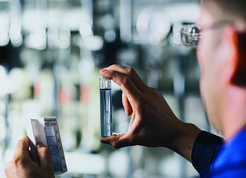
However, even if many findings are not put into practical application until decades later, basic research is and remains the foundation of economic innovation. In order to accelerate the transfer of promising findings to potential applications, the ties between basic and applied research must be strengthened. To this end, the Max Planck Society has recently begun expanding its cooperation projects with the Fraunhofer Society in certain fields, such as computer science, materials science, nano- and biotechnology, and regenerative energies, and explicitly promotes projects at the interface between applied and basic research.
Through its subsidiary Max Planck Innovation GmbH, the Max Planck Society ensures that scientific breakthroughs are converted to economic success. Max Planck Innovation brings patents and technologies to the market and assists founders in setting up new companies based on the research results of the Max Planck Society. Since 1979, the technology transfer company has assisted with ca. 4,300 inventions and closed over 2,600 license deals. Since the beginning of the 1990s it has advised about 146 spin-offs. In total Max Planck Innovation has generated a revenue of over 470 million euros for inventors, institutes and the Max Planck Society.
Continuing and Developing Tradition
"I was possessed of a burning desire to survive the crisis and to live long enough to be able to experience the turning point, the beginning of a rise," wrote Physics Nobel laureate Max Planck in 1942. After the war, he dedicated himself to preserving the Kaiser Wilhelm Society. Thanks to his international reputation, the structure of the institution was allowed to remain and, in 1948, it was re-established as the Max Planck Society. At that time, it comprised 25 institutes and research centers. In 1949, even before the Federal Republic of Germany was established, the federal states guaranteed the Society sustained institutional financing.


In its first years, its activities were based particularly on two principles: the focus was exclusively on basic research, far removed from any political or business influences, and institute directors were expressly required to meet the highest standards of scientific excellence. Since then, the practice of collaborating with institutions outside of Germany has gradually been cemented. The contact established with the Weizmann Institute in Rehovot, Israel in 1959 and the partnership forged with the Chinese Academy of Sciences in 1974 mark milestones in this regard.
The sixties were a period of unrivalled progress for the Max Planck Society. New research centers were established for biology and biochemistry. The spectrum of research in the fields of physics and chemistry expanded to include astronomy and solid state physics. Researchers in the humanities and social sciences were seeking answers to burning sociopolitical questions of the day and established new institutes, including several for subfields of the legal sciences and for education research. By 1966, the number of research institutes had grown to 52.
In the seventies and eighties, the Max Planck Society concentrated on innovative, interdisciplinary cutting-edge research in particularly promising fields and established specific programs, creating opportunities for young researchers to launch their international science careers. Then German reunification came, and the unique opportunity to set up 18 new institutes in eastern Germany through to 1998, opening the door to numerous new research areas.
With the start of the 21st century, the Max Planck Society is fortifying its institutional activity abroad: together with the Chinese Academy of Sciences, it established a Partner Institute in Shanghai. And the first Max Planck Institute in North America is now underway, financed by the State of Florida and Palm Beach County, showing that the Max Planck Society is exploring new ways to increase its financial flexibility.